We present EthicsBot, an innovative, open-source large language model (LLM) project that is being itereatively designed and developed at Wellesley College to provide real-time, context-aware ethical guidance for researchers. Our work addresses the critical need for timely and accessible ethical support in modern research, particularly when confronting complex digital data on the social web. By investigating the potential of LLMs to serve as research ethics support tools, our goal is to foster deeper ethical reflection that effectively complements, rather than merely complies with, formal institutional review board (IRB) processes.
Papers
EthicsBot: Fine-Tuning Open-Source LLMs to Assist Scientific Investigators in Analyzing Ethical Issues in Research
Abstract
Ethical considerations are fundamental to responsible research, yet many investigators struggle to identify and analyze ethical concerns in their study designs. Institutional review boards (IRBs) and other regulatory bodies, while essential, are often perceived as bureaucratic obstacles rather than collaborative partners in ethical inquiry. Recent advances in large language models (LLMs) offer an opportunity to enhance the way researchers engage with ethical analysis. This paper introduces EthicsBot, an innovative project that proposes to leverage open-source LLMs to provide real-time, context-aware ethical guidance for researchers. Download PDF
Comparing Human and LLM Ethical Analyses: A Case Study in Computational Social Science Research
Abstract
As researchers increasingly engage with ethically complex digital phenomena, timely and accessible support for ethical reflection is essential—yet often unavailable beyond formal institutional review processes, which are more focused on regulatory compliance than ethics. This paper investigates the potential of large language models (LLMs) to serve as re- search ethics support tools by providing immediate, context-sensitive feedback on draft research protocols. We analyze a draft research proposing to scrape digital platforms for data on "Sephora Kids" (a trend in which minors promote beauty products on platforms like YouTube and TikTok) as a case study to explore this possibility. Two human ethicists and two LLMs (GPT-4o and Claude 3.7 Sonnet) independently reviewed the proposal and produced ethical evaluations. We then compared the outputs to assess whether LLMs could meaningfully assist researchers in identifying and engaging with ethical issues. Our findings suggest that LLMs can already offer valuable support. Download PDF
Is AI the Answer? Envisioning LLM Support for Responsible Computer Science Research
Abstract
CS researchers are grappling with emerging technologies changing their field at an increasing pace, yet lack support from their institutions for upholding research integrity. To address this lack of support in conducting ethical research, we investigate the potential of deploying an LLM-powered tool to provide easily accessible guidance on research ethics practices. We present findings from interviews with 16 computer science researchers at various stages in their careers, ex- ploring their visions for how they would like to receive such guidance from an open-source LLM-based tool. Results from qualitative coding of the interviews reveal a wide range of possibilities: researchers imagined specific forms of support for ideation, development, revision, and final feedback. These findings highlight the potential benefits and challenges of us- ing LLMs to support research ethics in CS. Download paper PDF.
Download Supplemntal Materials for the study.
Our Team
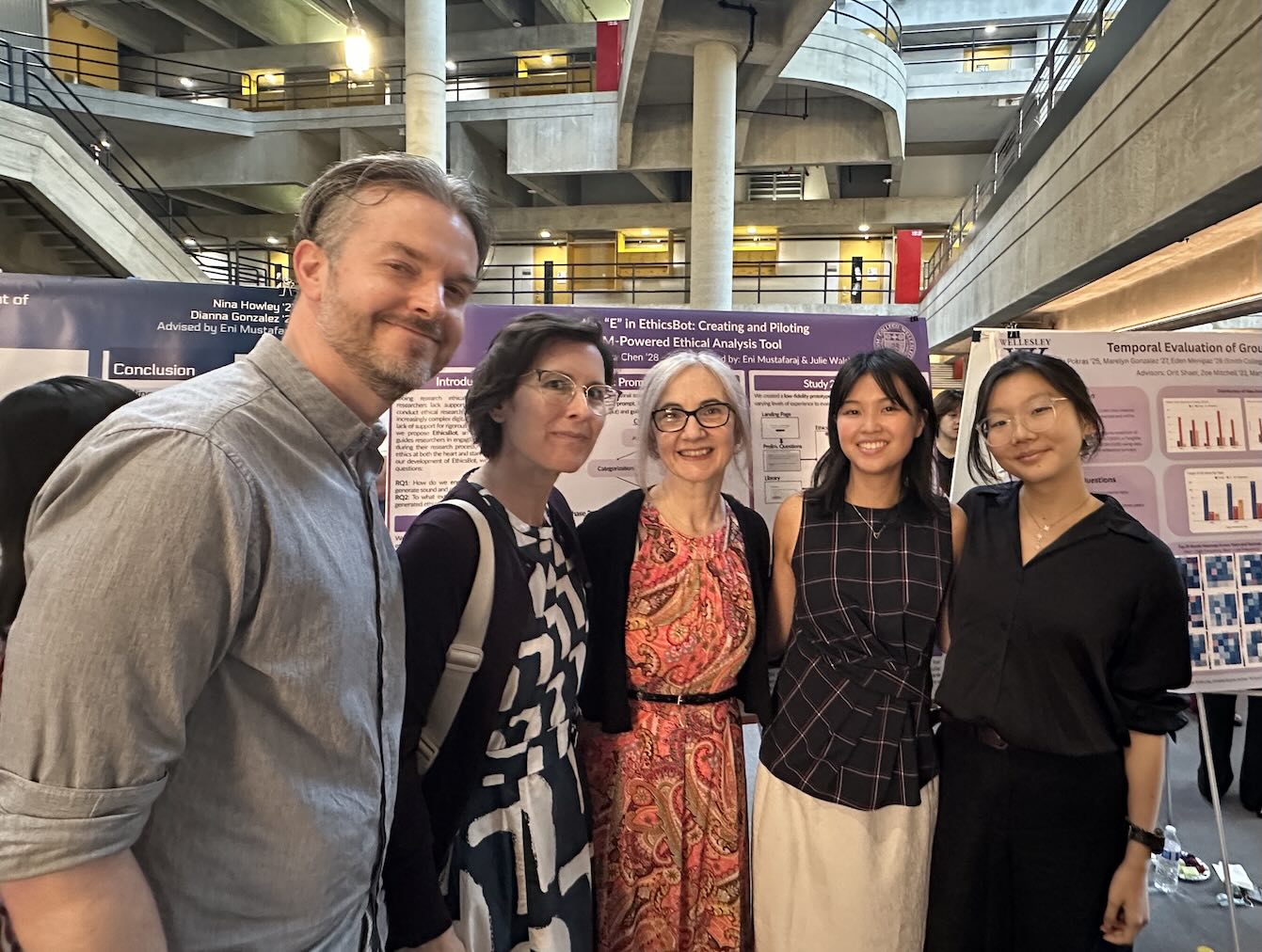
The core research group at the Wellesley College Science Center Summer Research Poster Session (July 2025).
Dr. Eni Mustafaraj
Affiliation: Wellesley College
Dr. Mustafaraj is an Associate Professor of Computer Science at Wellesley College. She is the PI of the NSF grant "Pathways to Ethics of Technology in the Liberal Arts Curriculum" that supports this research.
Dr. Julie Walsh
Affiliation: Wellesley College
Dr. Walsh is the Whitehead Associate Professor of Critical Thought and Associate Professor of Philosophy at Wellesley College. She is the co-PI of the NSF grant "Pathways to Ethics of Technology in the Liberal Arts Curriculum" that supports this research.
Dr. Spencer Philips Hey
Affiliation: Hey Research & Innovation
Dr. Hey is a the founder of Hey Research & Innovation. He has deep research expertise on the ethics of human subjects research. His publications can be found here.
Crystal Zhao
Affiliation: Wellesley College
Crystal is an undergraduate student at Wellesley College studying Data Science and Peace & Justice.
Jessica Chen
Affiliation: Wellesley College
Jessica an undergraduate student at Wellesley College studying Computer Science and Political Science.
Contact Us
For research inquiries, collaborations, or questions about the papers, please contact us at: .